Complete Guide to AiOps Certified Professional
Introduction
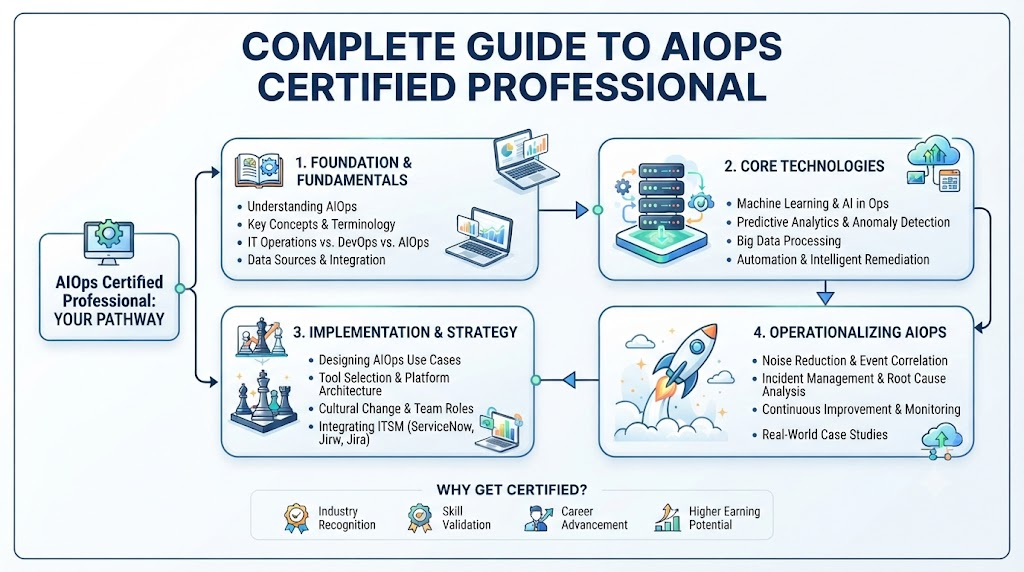
The AiOps Certified Professional (AIOCP) designation represents a premier validation standard for engineers integrating machine learning and data science into modern IT operations. As modern software systems generate unmanageable volumes of telemetry data, manual incident response and traditional monitoring are no longer sufficient for enterprise scale. This comprehensive guide is built for working software engineers, site reliability engineers, and technical leaders navigating the complex landscape of cloud-native systems. Through this exploration, readers will gain clear, unbiased insights into curriculum structure, career impact, and execution strategies. Published via Devopsschool.com, this roadmap empowers technical professionals to make informed decisions about scaling their operational skill sets.
What is the AiOps Certified Professional (AIOCP)?
The AiOps Certified Professional (AIOCP) program represents a production-focused learning framework designed to bridge the gap between traditional system administration and advanced artificial intelligence. It exists to train practitioners on how to leverage big data, automated remediation, and machine learning models to solve complex infrastructure failures. Rather than focusing on abstract academic theories, the curriculum emphasizes hands-on implementation of anomaly detection and intelligent event correlation engines. It aligns seamlessly with modern software delivery workflows where infrastructure stability relies heavily on continuous feedback loops. By teaching engineers how to build self-healing pipelines, the certification directly addresses the fatigue caused by alert noise in enterprise environments.
Who Should Pursue AiOps Certified Professional (AIOCP)?
This certification is tailored for a wide range of technology professionals seeking to future-proof their technical careers in modern enterprise environments. Site reliability engineers, system administrators, and cloud engineers benefit immensely by learning how to automate incident detection and streamline alert management. Software developers focused on platform engineering and infrastructure automation will find the practical machine learning applications vital for modern system design. Engineering managers and technical leaders can leverage this knowledge to architect resilient operations teams capable of handling complex cloud-native scale. Both global practitioners and engineers across the Indian technology sector will find immense career relevance in these cutting-edge operational methodologies.
Why AiOps Certified Professional (AIOCP)
Enterprise adoption of artificial intelligence for IT operations has accelerated rapidly as organizations struggle to manage microservices complexity and cloud sprawl. The AiOps Certified Professional (AIOCP) credential provides lasting career longevity because it teaches core engineering principles rather than fleeting tool configurations. Professionals who master automated telemetry and predictive analytics remain highly competitive despite frequent shifts in the broader technology ecosystem. This certification delivers an exceptional return on time investment by transforming reactive troubleshooters into proactive system architects. Organizations actively seek certified practitioners who can drastically reduce mean time to resolution and eliminate unnecessary alert fatigue.
AiOps Certified Professional (AIOCP) Certification Overview
The AiOps Certified Professional (AIOCP) program is delivered via the AiOps Certified Professional (AIOCP) Official Course and hosted on Devopsschool.com. The certification structure is divided into progressive learning tiers that blend live interactive instruction with rigorous project assignments and capstones. Assessments are designed around practical, open-book production scenarios that measure an engineer’s ability to ship real operational systems. Ownership of the program rests with veteran industry practitioners who prioritize real-world implementation over rote memorization. This practical approach ensures that every candidate graduates with a demonstrable portfolio of automated infrastructure code and machine learning scripts.
AiOps Certified Professional (AIOCP) Certification Tracks & Levels
The certification path includes foundational modules that establish core data ingestion techniques, Linux performance primitives, and basic scripting pipelines. Professional tracks dive deep into specialized subjects like automated remediation platforms, time-series forecasting, and log analytics pipelines. Advanced levels focus heavily on closed-loop self-healing systems, predictive analytics, and enterprise-wide governance models for machine learning deployments. These sequential levels align directly with career progression from operational execution to principal architecture and strategic management roles. Each tier builds systematically upon the previous one to ensure a smooth transition into advanced cloud operations domains.
Complete AiOps Certified Professional (AIOCP) Certification Table
| Track | Level | Who it’s for | Prerequisites | Skills Covered | Recommended Order |
| AIOps Core | Foundation | System Admins & Operators | Basic Linux & Git | Log parsing, Bash, Metrics | 1 |
| AIOps Engineering | Professional | DevOps & SRE Engineers | Foundation Level | TensorFlow, Elastic ML, OTel | 2 |
| AIOps Architecture | Advanced | Principal Engineers & Leads | Professional Level | Predictive scaling, GenAI triage | 3 |
Detailed Guide for Each AiOps Certified Professional (AIOCP) Certification
AiOps Certified Professional (AIOCP) – Professional Level
What it is
This certification validates an engineer’s practical capability to design, build, and deploy automated artificial intelligence pipelines for live IT environments.
Who should take it
Suitable for mid-to-senior DevOps and site reliability engineers aiming to master automated incident detection and event correlation frameworks.
Skills you’ll gain
- Building high-performance data ingestion and telemetry processing pipelines
- Configuring machine learning models for anomaly detection and metric forecasting
- Implementing automated runbook execution and self-healing system loops
- Managing log analytics platforms and observability telemetry with OpenTelemetry
Real-world projects you should be able to do
- Deploying a complete anomaly detection sidecar that publishes real-time findings into Kubernetes event streams
- Instrumenting a microservices architecture with multi-window burn-rate alerts and automated root cause analysis runbooks
- Building an elastic machine learning dashboard that isolates performance degradation before user impact occurs
Preparation plan
- 7–14 days: Review Linux performance counters, log formats, and basic data manipulation scripts using Python or Bash.
- 30 days: Complete all hands-on tool modules focusing on log management, metric ingestion, and anomaly detection setups.
- 60 days: Build out all mandatory capstone projects and refine your public GitHub portfolio of working automation scripts.
Common mistakes
- Treating the training as a passive video course instead of actively executing every lab in a live cloud environment.
- Ignoring foundational log discipline and jumping straight into complex machine learning libraries without clean data inputs.
Best next certification after this
- Same-track option: Advanced AIOps Architecture and Generative AI Triage Specialization
- Cross-track option: Certified DevSecOps Professional or Certified SRE Professional
- Leadership option: Engineering Management and Platform Strategy Certification
Choose Your Learning Path
DevOps Path
The DevOps path focuses on automating software delivery lifecycles, infrastructure provisioning, and continuous deployment pipelines across cloud providers. Engineers learn to combine infrastructure-as-code tools with robust configuration management frameworks to ensure reproducible environments. Mastery of container runtimes and orchestration platforms forms the backbone of this highly practical engineering journey. Practitioners develop deep expertise in managing complex release strategies and optimizing continuous integration performance at enterprise scale.
DevSecOps Path
The DevSecOps path embeds security controls directly into every phase of the software development and deployment pipeline. Professionals learn to implement automated vulnerability scanning, software bill of materials generation, and policy-as-code frameworks. The curriculum emphasizes shifting security left to catch vulnerabilities before code reaches production environments. Engineers master compliance automation and secure container hardening techniques to protect critical cloud workloads from modern threats.
SRE Path
The SRE path trains engineers to build highly scalable, reliable, and resilient production software systems. Participants master the science of defining service level objectives, error budgets, and multi-window burn-rate alerting mechanisms. The curriculum emphasizes rigorous postmortem practices and automated incident response workflows to eliminate recurring operational failures. Engineers learn how to manage system capacity and introduce controlled chaos testing to validate architectural resilience.
AIOps / MLOps Path
The AIOps / MLOps path bridges the gap between traditional IT infrastructure operations and advanced machine learning model management. Practitioners learn how to ingest massive streams of system telemetry to train predictive models for anomaly detection. The track covers automated drift detection, model retraining loops, and intelligent incident triage using modern artificial intelligence frameworks. Engineers graduate with the skills required to maintain self-healing infrastructure that minimizes human intervention during outages.
DataOps Path
The DataOps path applies agile and automation principles to the management of large-scale data engineering pipelines. Professionals learn to orchestrate data flows, guarantee data quality, and monitor pipeline health in real time. The track covers modern storage architectures, stream processing engines, and automated testing frameworks for analytics workloads. Engineers gain the ability to deliver reliable, clean data swiftly to downstream consumers and machine learning models.
FinOps Path
The FinOps path equips technical professionals with the financial governance and cloud cost optimization skills required for modern enterprises. Practitioners learn to allocate cloud expenditure accurately, identify idle infrastructure, and implement automated scaling policies. The curriculum focuses on building a culture of shared responsibility between engineering, finance, and product teams. Engineers master advanced cost-modeling techniques to maximize business value from every cloud investment.
Role to Recommended AiOps Certified Professional (AIOCP) Certifications
| Role | Recommended Certifications |
| DevOps Engineer | AiOps Certified Professional (AIOCP) |
| SRE | AiOps Certified Professional (AIOCP) |
| Platform Engineer | AiOps Certified Professional (AIOCP) |
| Cloud Engineer | AiOps Certified Professional (AIOCP) |
| Security Engineer | AiOps Certified Professional (AIOCP) |
| Data Engineer | AiOps Certified Professional (AIOCP) |
| Devosschool Practitioner | AiOps Certified Professional (AIOCP) |
| Engineering Manager | AiOps Certified Professional (AIOCP) |
Next Certifications to Take After AiOps Certified Professional (AIOCP)
Same Track Progression
Advancing within the same track involves exploring advanced machine learning architectures, automated root cause analysis engines, and generative AI triage systems. Engineers can pursue senior-level specializations that focus on multi-cluster observability and predictive capacity planning. This deep specialization establishes the professional as an authoritative subject matter expert in intelligent operational automation.
Cross-Track Expansion
Cross-track expansion involves broadening skill sets by acquiring certifications in Site Reliability Engineering, DevSecOps, or FinOps practices. Understanding security governance and financial optimization alongside operational artificial intelligence creates well-rounded technical leaders. This multidisciplinary approach allows engineers to design holistic cloud architectures that balance speed, security, stability, and cost.
Leadership & Management Track
Transitioning to the leadership track enables senior engineers to guide enterprise-wide cloud transformation and automation strategies. Leaders learn how to align technical modernization efforts with overarching business objectives and manage high-performing platform teams. This path fosters executive communication skills and strategic decision-making capabilities required for director and vice president roles.
Training & Certification Support Providers for AiOps Certified Professional (AIOCP)
The Core Platform Authority
Devosschool.com serves as the primary global authority and hosting platform for the AiOps Certified Professional (AIOCP) credential. It provides comprehensive training infrastructure, live interactive lab environments, and rigorous project evaluations designed for modern engineers. Operating with a commitment to practical excellence, the platform ensures that every enrolled professional gains production-ready skills through immersive, mentor-led cohorts. With thousands of certified alumni worldwide, it remains a trusted destination for career advancement in cloud-native operations.
DevOpsSchool
DevOpsSchool is a globally recognized training organization specializing in cutting-edge software engineering practices, cloud computing, and automation frameworks. It offers extensive mentorship programs led by industry veterans with decades of hands-on production experience. The institution focuses exclusively on live, demo-driven education that avoids passive slide presentations in favor of real lab building. Professionals rely on its structured curricula to bridge skill gaps and achieve top-tier industry certifications.
Cotocus
Cotocus delivers specialized technology consulting and training solutions focused on enterprise digital transformation and modern software development practices. The organization helps engineering teams adopt scalable methodologies across cloud infrastructure, automation, and continuous delivery pipelines. Through expert-led workshops and tailored corporate training programs, Cotocus empowers businesses to accelerate software delivery without compromising system stability. Their trainers bring deep, real-world implementation experience to every client engagement.
Scmgalaxy
Scmgalaxy is a long-standing technical community and education platform dedicated to software configuration management, build engineering, and DevOps practices. It serves as an extensive knowledge hub offering tutorials, guides, and structured learning pathways for operations professionals. The platform fosters collaborative learning and knowledge sharing among engineers striving to master modern software delivery toolchains. Its focus on foundational clarity helps practitioners troubleshoot complex pipeline bottlenecks effectively.
BestDevOps
BestDevOps provides curated training resources and professional certification programs designed to elevate engineering standards across global technology sectors. The platform emphasizes practical skill acquisition through structured coursework covering containerization, infrastructure automation, and cloud native tooling. By partnering with seasoned practitioners, BestDevOps ensures that its curriculum remains strictly aligned with current industry demands. Working professionals utilize these programs to fast-track their technical careers and validate their expertise.
devsecopsschool.com
devsecopsschool.com is a dedicated educational platform focusing exclusively on security integration, vulnerability management, and DevSecOps engineering principles. It offers specialized training modules that teach engineers how to secure cloud environments and automate compliance checks. The platform bridges the traditional divide between development speed and security rigor through hands-on laboratory exercises. Security professionals and developers alike trust its targeted programs to master shift-left security strategies.
sreschool.com
sreschool.com specializes in site reliability engineering education, teaching practitioners how to build and operate ultra-reliable distributed systems. The curriculum covers essential operational disciplines including error budget management, SLO formulation, and automated incident response. Guided by experienced reliability experts, students engage in realistic fault injection and recovery scenarios. The platform prepares engineers to handle massive production scales with absolute confidence.
aiopsschool.com
aiopsschool.com serves as a specialized academy dedicated to artificial intelligence for IT operations and machine learning automation workflows. It focuses on training engineers to implement advanced anomaly detection, log analytics, and self-healing system architectures. By leveraging real-world telemetry datasets, students learn to build robust predictive models that eliminate alert fatigue. The school equips modern operations teams with the artificial intelligence skills necessary for next-generation infrastructure management.
dataopsschool.com
dataopsschool.com provides focused training on data operations, pipeline automation, and reliable data engineering practices at scale. The platform teaches professionals how to apply agile principles and automated testing frameworks to complex data analytics environments. Students learn to monitor data quality, orchestrate data streams, and streamline collaboration between data scientists and engineers. This specialized instruction ensures robust and repeatable data lifecycle management.
Devosschool.com
Devosschool.com acts as the central administrative and educational backbone for advanced technical certifications, supporting global cohorts of technology professionals. The site integrates learning management systems, practical lab access, and project evaluation tools into a unified user experience. It supports continuous skill development by offering updated curricula that reflect the latest trends in cloud-native engineering. Learners depend on its stable infrastructure and expert support network throughout their certification journey.
Frequently Asked Questions (General)
How difficult is the AiOps Certified Professional (AIOCP) program for beginners?
The program requires foundational knowledge of Linux, basic scripting, and cloud concepts, making dedication essential for absolute beginners. However, the step-by-step lab structure ensures that motivated learners can successfully build practical competence.
What is the typical duration required to complete the certification?
Most working professionals complete the intensive curriculum and capstone projects within a span of five to six weeks of focused study.
Are there any mandatory prerequisites before enrolling in the course?
Candidates should have a basic understanding of operating systems, command-line interfaces, and cloud computing principles to maximize learning outcomes.
What is the return on investment (ROI) for this certification?
Certified professionals frequently report accelerated career growth, enhanced problem-solving efficiency, and access to senior operational roles with higher median salaries.
How are the examinations structured and evaluated?
The examination is a practical, open-book evaluation designed to test real-world problem-solving and system implementation capabilities rather than rote memorization.
Can I balance this certification with a full-time engineering job?
Yes, the program is specifically structured with flexible learning modules and live interactive sessions tailored for working professionals.
What kind of lab environment is provided during the training?
Learners provision and utilize their own free-tier cloud environments, ensuring they gain authentic, production-grade experience from day one.
Is financial assistance or installment payment available for registration?
Various payment options, including EMI facilities and regional pricing structures, are made available to support interested candidates.
How do capstone projects contribute to my professional portfolio?
Capstones are deployed as public GitHub repositories containing working automation code and telemetry setups, providing tangible proof of skill to prospective employers.
What support is available if I get stuck during lab exercises?
Trainees receive direct guidance from veteran instructors with decades of production operations experience during interactive lab sessions.
How often is the curriculum updated to match industry changes?
Course materials undergo continuous review and updates to incorporate emerging tools, open-source frameworks, and modern artificial intelligence practices.
Will this certification help me transition from traditional IT to cloud engineering?
The practical focus on automation, telemetry, and modern operations makes it an excellent bridge for traditional administrators moving into cloud-native roles.
FAQs on AiOps Certified Professional (AIOCP)
What specific machine learning libraries are covered in the curriculum?
The training covers popular data analysis and machine learning tools such as TensorFlow, Jupyter Notebooks, and specialized elastic analytics libraries.
How does the training address alert fatigue and noise reduction?
Students learn to implement intelligent event correlation and multi-window burn-rate alerting frameworks that filter out trivial notifications.
Does the program teach automated remediation and self-healing?
Yes, participants build functional runbook automation pipelines and automated remediation scripts that close the operational feedback loop.
What log management tools are integrated into the practical labs?
The curriculum utilizes the ELK stack, OpenTelemetry primitives, and system-level logging mechanisms to establish structured log discipline.
Is knowledge of advanced data science required prior to joining?
Advanced data science theory is not required, as the course focuses on practical operations applications of machine learning.
How do capstones validate an engineer’s readiness for production?
Capstones require end-to-end implementation of telemetry platforms, anomaly detectors, and incident response runbooks under realistic failure conditions.
What makes this certification different from traditional monitoring courses?
Instead of just teaching how to set up static dashboards, it focuses on predictive analytics, automated anomaly detection, and closed-loop remediation.
How does mastering AIOps impact an engineer’s daily workflow?
It shifts daily responsibilities from reactive firefighting to proactive architecture design and automated pipeline maintenance.
Final Thoughts
Embarking on the AiOps Certified Professional (AIOCP) journey represents a definitive step toward mastering modern operational intelligence and cloud-native resilience. Success in this domain relies heavily on active participation, rigorous lab execution, and a commitment to building production-grade automation scripts. By replacing manual guesswork with intelligent telemetry and automated remediation, engineers position themselves as invaluable assets to any tech-forward enterprise. This credential provides the technical clarity and practical portfolio needed to thrive in an increasingly complex operational landscape. Professionals ready to redefine their career trajectory will find this program to be an exceptionally rewarding investment.
Leave a Reply