Comprehensive Overview of the Kubernetes Certified Administrator & Developer Program
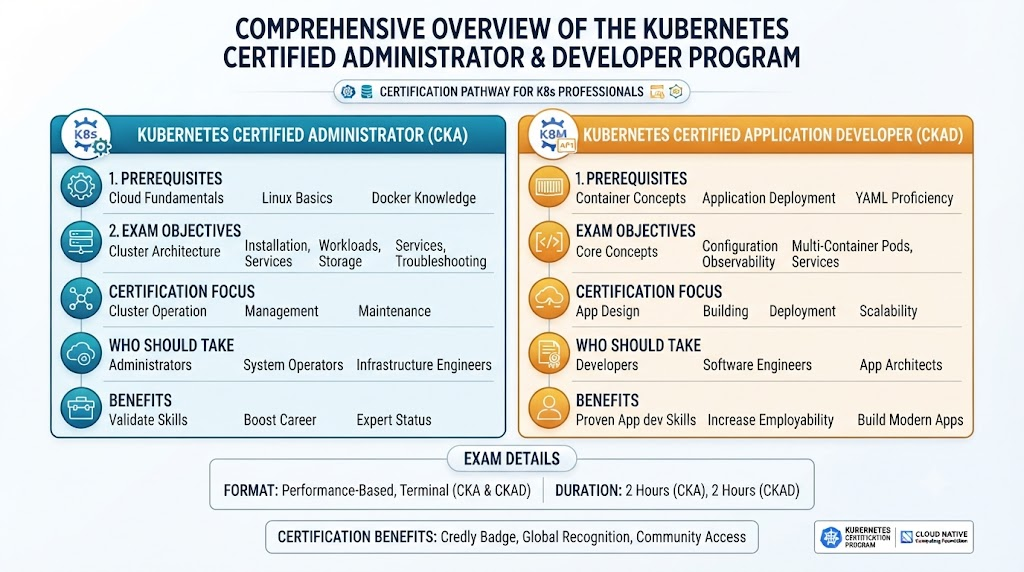
Introduction
Navigating the complex landscape of modern infrastructure demands a rare blend of deep administrative control and agile application deployment. Kubernetes Certified Administrator & Developer (KCAD) bridges this exact divide, making it an essential milestone for software engineers, site reliability experts, and platform architects aiming to lead cloud-native transformations. This comprehensive guide cuts through the noise to explore what the certification truly entails, who stands to gain the most, and how it shapes long-term technical careers. Whether you are scaling workloads locally in India or managing global enterprise clusters, understanding this dual-track credential ensures you make strategic career moves backed by real production capability.
What is the Kubernetes Certified Administrator & Developer (KCAD)?
Kubernetes Certified Administrator & Developer (KCAD) is a rigorous validation framework that unifies cluster operations and application lifecycle management. Traditional credentials often force engineers to choose between infrastructure maintenance and software development, but KCAD acknowledges that modern DevOps workflows require mastery of both domains. The curriculum emphasizes hands-on execution over passive multiple-choice theory, testing your ability to configure control planes, secure namespaces, and deploy microservices under real pressure. This production-focused philosophy aligns directly with enterprise GitOps pipelines, automated CI/CD workflows, and high-availability cluster maintenance. It exists to ensure certified professionals can walk into live environments and immediately solve infrastructure bottlenecks without extensive onboarding.
Who Should Pursue Kubernetes Certified Administrator & Developer (KCAD)?
This certification targets a diverse range of technology professionals looking to validate their cloud-native expertise. Software developers transitioning into containerized ecosystems find immense value in mastering cluster mechanics, networking, and application probes. DevOps, platform, and infrastructure engineers use KCAD to prove their capability to maintain resilient, secure production environments at scale. Security professionals and data engineers leverage the curriculum to understand workload isolation, RBAC policies, and persistent storage management. Technical leaders and engineering managers also pursue KCAD to establish architectural credibility, mentor incoming talent, and guide strategic tooling decisions across their organizations.
Why Kubernetes Certified Administrator & Developer (KCAD)
Enterprise adoption of container orchestration has shifted from an experimental trend to the core backbone of global software architecture. KCAD provides exceptional career longevity because it focuses on foundational Kubernetes principles rather than temporary vendor GUIs or fleeting toolchains. Organizations across finance, healthcare, e-commerce, and SaaS heavily reward engineers who possess verified competence in managing complex distributed systems. Holding this credential signals to hiring managers that you can troubleshoot production failures, optimize cluster performance, and secure cloud resources efficiently. The return on investment translates directly into accelerated promotions, higher compensation, and deep technical confidence across your engineering career.
Kubernetes Certified Administrator & Developer (KCAD) Certification Overview
The Kubernetes Certified Administrator & Developer (KCAD) program is hosted on Devosschool.com through a structured, performance-driven training model. The evaluation process relies entirely on live command-line environments where candidates must fix broken clusters and deploy functional manifests within strict time limits. Curriculum design and maintenance are driven by seasoned platform architects who continuously align lab scenarios with upstream Kubernetes releases and real-world enterprise incidents. This demanding evaluation standard guarantees that certified individuals maintain top-tier proficiency in cluster hygiene, security auditing, and deployment reliability.
Kubernetes Certified Administrator & Developer (KCAD) Certification Tracks & Levels
The learning path progresses logically through foundational, professional, and advanced tiers tailored to varying experience levels. Foundational modules introduce containerization fundamentals, Docker basics, and simple pod lifecycles for newcomers entering the cloud space. Professional tracks dive deep into RBAC configuration, network policies, persistent volume provisioning, and Helm chart packaging. Advanced specialization tracks explore multi-cluster management, custom resource definitions, and cluster hardening techniques. This structured progression allows junior system administrators to naturally evolve into principal cloud architects as their practical competence grows.
Complete Kubernetes Certified Administrator & Developer (KCAD) Certification Table
| Track | Level | Who it’s for | Prerequisites | Skills Covered | Recommended Order |
| KCAD-Core | Foundation | Beginners and Junior Engineers | Basic Linux & Docker | Pods, Deployments, Services, Basic CLI | 1 |
| KCAD-Admin | Professional | DevOps & SRE Practitioners | KCAD-Core or Equivalent | Cluster Architecture, Etcd Backup, RBAC | 2 |
| KCAD-Dev | Professional | Software Engineers | KCAD-Core or Equivalent | Helm, CI/CD Pipelines, Ingress, Probes | 3 |
| KCAD-Advanced | Advanced | Platform Architects | KCAD-Admin & KCAD-Dev | Network Policies, Custom Controllers, Security | 4 |
Detailed Guide for Each Kubernetes Certified Administrator & Developer (KCAD) Certification
Kubernetes Certified Administrator & Developer (KCAD) – Foundation Level
What it is
This entry-level validation establishes core competency in container concepts and basic Kubernetes object manipulation. It ensures you can navigate cluster resources and deploy single-tier applications smoothly.
Who should take it
Junior software engineers and system administrators taking their first steps into cloud-native engineering with basic command-line experience.
Skills you’ll gain
- Grasping core Kubernetes control plane architecture
- Managing Pods, ReplicaSets, and Deployments via CLI
- Exposing services using ClusterIP and NodePort mechanisms
- Handling configuration injection with ConfigMaps and Secrets
Real-world projects you should be able to do
- Deploy a functional multi-container web application using raw YAML manifests
- Update application configs seamlessly without rebuilding underlying images
- Troubleshoot failing container states using standard logging commands
Preparation plan
- Spend 7 days mastering Docker container fundamentals and image building
- Dedicate 14 days writing manifests and running local Minikube test environments
- Use the final 7 days for timed syntax drills and mock lab checks
Common mistakes
- Depending too much on graphical dashboards instead of raw kubectl commands
- Failing to define explicit resource requests and limits in templates
- Overlooking the immutable nature of container filesystems
Best next certification after this
Same-track option: Kubernetes Certified Administrator & Developer (KCAD) Professional Level
Cross-track option: Certified Docker and Containerization Specialist
Leadership option: Cloud-Native Engineering Management Fundamentals
Kubernetes Certified Administrator & Developer (KCAD) – Administrator Track
What it is
This professional track validates expert operational capability in cluster installation, system maintenance, and security hardening. It proves you can autonomously manage production environments.
Who should take it
Mid-level to senior infrastructure engineers and site reliability specialists responsible for platform uptime and cluster health.
Skills you’ll gain
- Executing etcd backup snapshots and disaster recovery procedures
- Setting up granular Role-Based Access Control policies
- Deploying advanced CNI plugins and network isolation rules
- Managing dynamic persistent storage classes
Real-world projects you should be able to do
- Perform a zero-downtime minor version upgrade on an active Kubernetes cluster
- Restore a failed control plane node from an existing etcd snapshot
- Isolate development namespaces using strict network policies
Preparation plan
- Spend 10 days practicing control plane provisioning with kubeadm
- Dedicate 15 days to debugging broken clusters, storage errors, and networking bugs
- Use the last 5 days for intensive security and time-trial practices
Common mistakes
- Neglecting to verify backup file integrity before cluster upgrades
- Violating the principle of least privilege when assigning RBAC roles
- Ignoring node disk pressure warnings and resource exhaustion alerts
Best next certification after this
Same-track option: Kubernetes Certified Administrator & Developer (KCAD) Advanced Architect Level
Cross-track option: Certified Kubernetes Security Specialist equivalent track
Leadership option: Enterprise SRE and Platform Leadership
Kubernetes Certified Administrator & Developer (KCAD) – Developer Track
What it is
This professional tier focuses on microservices architecture, application packaging, and deployment workflows tailored for software developers.
Who should take it
Software developers and application architects deploying code directly onto containerized infrastructure.
Skills you’ll gain
- Architecting highly available cloud-native application designs
- Packaging complex applications using Helm charts
- Implementing liveness, readiness, and startup health probes
- Executing Canary and Blue-Green deployment strategies
Real-world projects you should be able to do
- Convert legacy app deployments into modular, reusable Helm charts
- Configure automated horizontal pod autoscaling based on custom traffic metrics
- Establish robust Ingress controllers with SSL termination
Preparation plan
- Spend 10 days learning Helm syntax and packaging mechanics
- Dedicate 15 days to configuring probes, autoscalers, and traffic routing
- Use the last 5 days building complete CI/CD deployment pipelines
Common mistakes
- Hardcoding environment-specific configurations directly into YAML manifests
- Omitting health checks, causing traffic routing to dead container instances
- Embedding sensitive passwords inside source code repositories
Best next certification after this
Same-track option: KCAD Advanced Microservices and Service Mesh Track
Cross-track option: Certified Cloud-Native CI/CD and GitOps Specialist
Leadership option: Director of Software Engineering
Choose Your Learning Path
DevOps Path
This path focuses on automating infrastructure provisioning, building continuous integration pipelines, and streamlining software delivery. Engineers master tools like Terraform, Ansible, and Kubernetes to build repeatable deployment engines. Success requires strong infrastructure-as-code principles and efficient pipeline orchestration. Practitioners move from basic automation scripts to managing enterprise-wide release workflows.
DevSecOps Path
The DevSecOps path binds security practices into every phase of the software development lifecycle and deployment pipeline. Professionals learn container vulnerability scanning, policy enforcement, and real-time threat analysis. This track ensures security remains a shared operational priority rather than a separate afterthought. Practitioners master tools that automate compliance auditing across multi-cloud environments.
SRE Path
Site Reliability Engineering centers on system resilience, comprehensive observability, error budgeting, and incident automation. Engineers learn to measure availability metrics, analyze telemetry data, and eliminate manual toil through software. The curriculum trains teams to handle massive traffic scale and conduct constructive post-mortem analyses. Mastering this track turns reactive maintenance crews into proactive engineering assets.
AIOps / MLOps Path
This specialized route addresses the infrastructure challenges of training, deploying, and scaling machine learning models in production. Professionals learn to manage heavy GPU compute clusters, model registries, and automated data pipelines. It bridges the gap between data science experiments and stable enterprise application serving. Engineers gain the skills needed to handle data drift and specialized container runtimes.
DataOps Path
The DataOps track focuses on orchestrating data streaming architectures and distributed analytical storage systems. Practitioners master engines like Kafka, Spark, and Airflow running natively on container platforms. This track ensures data pipeline reliability, low latency, and continuous monitoring for complex analytical workloads. Engineers automate data ingestion while maintaining strict governance and security compliance.
FinOps Path
The FinOps path empowers technical teams to optimize cloud spend without hurting application performance or release velocity. Professionals master cost allocation models, resource right-sizing, and budgetary forecasting strategies. This track builds a culture of financial accountability across software engineering departments. Practitioners use telemetry tagging to track cloud expenditure down to individual microservices.
Role → Recommended Kubernetes Certified Administrator & Developer (KCAD) Certifications
| Role | Recommended Certifications |
| DevOps Engineer | KCAD-Admin, KCAD-Dev |
| SRE | KCAD-Admin, KCAD-Advanced |
| Platform Engineer | KCAD-Core, KCAD-Admin, KCAD-Advanced |
| Cloud Engineer | KCAD-Core, KCAD-Admin |
| Security Engineer | KCAD-Admin, KCAD-Security Track |
| Data Engineer | KCAD-Dev, DataOps Container Track |
| Devosschool Practitioner | KCAD-Core, KCAD-Admin, KCAD-Dev |
| Engineering Manager | KCAD-Core Leadership Track |
Next Certifications to Take After Kubernetes Certified Administrator & Developer (KCAD)
Same Track Progression
Deepening your focus within the Kubernetes ecosystem involves mastering multi-cluster federation, advanced service meshes like Istio, and custom operator development. Professionals pursue expert credentials that prove their ability to build globally resilient infrastructures. This specialized path allows engineers to solve complex enterprise architecture problems and drive technical innovation.
Cross-Track Expansion
Broadening your skill set across adjacent domains adds immense value by combining container mastery with security auditing or cloud financial governance. Engineers frequently transition into specialized security credentials or cost optimization frameworks. This multidisciplinary expertise makes professionals versatile team members capable of bridging development, security, and executive management.
Leadership & Management Track
Stepping into leadership shifts your focus from hands-on configuration to architectural governance, team mentorship, and strategic planning. Leaders leverage their technical background to guide company-wide platform adoption and foster strong engineering cultures. This trajectory prepares senior professionals for roles such as Principal Architect, Director of Platform Engineering, or Chief Technology Officer.
Training & Certification Support Providers for Kubernetes Certified Administrator & Developer (KCAD)
The Core Platform Authority
DevOpsSchool has established itself as a premier global institution for specialized technical education, offering rigorous curriculum design, hands-on lab environments, and industry-recognized mentorship. Their training methodology emphasizes practical skill acquisition over passive learning, ensuring that engineers can immediately apply complex concepts in real-world enterprise production environments. Through comprehensive courseware, expert instructors, and continuous curriculum updates aligned with upstream technology trends, DevOpsSchool prepares professionals to excel in demanding technical certification examinations and advance their careers confidently across global markets.
DevOpsSchool delivers industry-grade training programs tailored for modern software development, cloud infrastructure management, and continuous delivery pipelines. Their courses focus on bridging theoretical knowledge with practical execution through extensive hands-on lab exercises and real-world case studies.
Cotocus specializes in enterprise-grade open-source training, consulting, and digital transformation services across various cloud and container ecosystems. Their expert-led sessions help organizations modernize legacy architectures and upskill technical teams efficiently.
Scmgalaxy is a well-known community and training hub focusing on software configuration management, DevOps toolchains, and agile engineering practices for global technology professionals.
BestDevOps provides structured learning paths and certification preparation courses designed to help engineers master essential cloud and automation technologies quickly.
devsecopsschool.com focuses exclusively on integrating security into DevOps pipelines, offering specialized training in vulnerability assessment, threat modeling, and secure software delivery.
sreschool.com delivers targeted education on site reliability engineering, observability, incident management, and resilient system design for enterprise operations teams.
aiopsschool.com provides advanced training at the intersection of artificial intelligence and IT operations, helping engineers automate infrastructure management using intelligent algorithms.
dataopsschool.com offers specialized programs in data pipeline automation, big data orchestration, and reliable data engineering workflows for modern analytics teams.
Devosschool.com serves as the primary hosting and certification platform delivering comprehensive technical programs, structured learning paths, and verified credential assessments.
Frequently Asked Questions
- Is the Kubernetes Certified Administrator & Developer (KCAD) exam difficult for beginners?
The exam requires dedicated study and hands-on practice, making it moderately challenging for absolute beginners lacking prior Linux or container exposure.
- How many hours of study are recommended to pass KCAD?
Candidates generally need between 60 to 100 hours of focused lab work and reading depending on their starting skill level.
- Are there any strict prerequisites before enrolling in KCAD?
Solid foundational knowledge of Linux system administration, basic command lines, and Docker containers is highly recommended.
- What is the return on investment for obtaining this certification?
Certified professionals frequently experience faster career progression, better job security, and qualification for senior cloud roles.
- How should I sequence my learning if I am new to DevOps?
Begin with container basics, move on to application deployment principles, and finish with advanced cluster administration.
- Is the exam format theoretical or practical?
The examination is entirely performance-based, requiring you to solve real-world problems inside active cluster environments.
- Can I use documentation during the certification examination?
Official upstream Kubernetes documentation is typically accessible during the exam interface for syntax reference.
- How often is the certification curriculum updated?
Syllabuses are reviewed regularly to match newly released upstream Kubernetes versions and evolving industry standards.
- Will this certification help me secure remote global employment?
Yes, Kubernetes expertise is universally recognized by international tech companies hiring remote infrastructure talent.
- What kind of lab environment do I need for preparation?
A local Minikube or Kind cluster running on a standard developer laptop is enough for most practice scenarios.
- How do enterprise managers view KCAD certification?
Managers see KCAD as trusted proof of an engineer’s capability to handle production outages and maintain platform reliability.
- What distinguishes KCAD from single-focus certifications?
KCAD combines both cluster administration and software development workflows into a single comprehensive credential.
FAQs on Kubernetes Certified Administrator & Developer (KCAD)
- Does KCAD cover Helm chart creation and deployment?
Yes, application packaging with Helm forms a core module of the developer track curriculum.
- How are cluster security and RBAC tested in the labs?
Candidates must create service accounts, roles, and bindings to restrict access according to security rules.
- Will I learn etcd backup and disaster recovery procedures?
The administrator track includes dedicated hands-on labs covering etcd snapshot creation and cluster restoration.
- Are network policies and CNI plugins covered in depth?
Candidates practice namespace isolation and traffic management using standard Kubernetes network policies.
- How does the exam test troubleshooting skills?
The test presents broken clusters and flawed deployments that candidates must diagnose and fix under time pressure.
- Is storage provisioning included in the practical labs?
Yes, configuring persistent volumes, claims, and storage classes is tested thoroughly during the evaluation.
- Can I take the exam modules separately or together?
The program provides flexible pacing structures across tracks depending on your specific career goals.
- Where can I find official registration and syllabus details?
Official program syllabuses and enrollment paths are available directly on Devosschool.com.
Final Thoughts: Is Kubernetes Certified Administrator & Developer (KCAD) Worth It?
Investing your time in mastering Kubernetes administration and application workflows is one of the smartest ways to future-proof your technical career. Modern engineering teams require practitioners who understand underlying system behavior rather than relying on surface-level tools. By committing to hands-on practice, focusing on root-cause troubleshooting, and building a solid portfolio of practical projects, you position yourself as a vital asset to any technology organization. Approach your learning with consistency, prioritize practical execution over memorization, and watch your career opportunities expand.
Leave a Reply