Your Complete Guide to DevSecOps Training, Courses, and Careers
Introduction
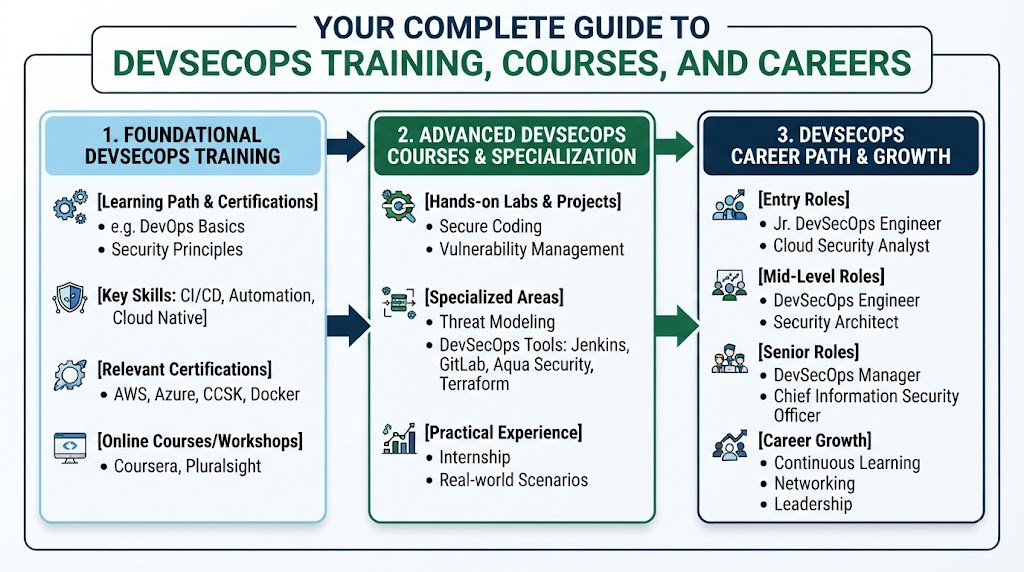
Building and releasing software today happens at lightning speed. To keep up with user demands, engineering teams rely on DevOps to push out new features and updates almost daily. But in the rush to deliver quickly, security is sometimes left on the back burner. When safety checks only happen at the very end of a project, applications become sitting ducks for cyber threats. This exact challenge is why DevSecOps has become one of the most exciting and sought-after fields in tech right now. Organizations are actively hunting for engineers who know how to protect cloud environments without putting the brakes on innovation. By jumping into structured learning programs, you can pick up the exact skills needed to lock down code across the entire development cycle. Earning a credential along the way is a great way to prove your knowledge, but real hands-on practice is what actually makes you job-ready. Platforms like DevSecOpsSchool.com offer great training courses designed to guide both newcomers and seasoned pros through this exact journey.
What Is DevSecOps Anyway?
Think of DevSecOps as the natural evolution of software development. In the past, security teams sat in a separate corner, reviewing code only after it was completely finished. This often led to massive delays and endless finger-pointing between developers and security staff. DevOps changed the game by bringing developers and operations teams together, and DevSecOps simply brings security right into that same circle from day one.
The core philosophy is all about shifting left—meaning you catch and fix security flaws while you are still writing the code, rather than weeks after launch. Automation does the heavy lifting here. Instead of manual code reviews slowing things down, automated tools scan for vulnerabilities in the background. Fixing a bug while coding takes mere minutes, whereas patching a live exploit later can take days.
What to Expect from DevSecOps Training
Jumping into dedicated DevSecOps Training helps bridge the gap between fast-paced deployments and rock-solid safety. Most beginner-friendly programs start with the basics, showing how development, operations, and security intersect in the real world. You learn how to write cleaner code that naturally resists common hacking techniques.
From there, the curriculum usually moves into CI/CD pipeline security, teaching you how to protect the automated pathways that push code into production. You will also look at secrets management, which ensures sensitive passwords and API keys never get accidentally exposed in public repositories. Because almost everything runs in the cloud today, training naturally covers cloud security, infrastructure protection, and container hardening. The goal isn’t just memorizing theory—it is about gaining practical habits you can use on the job tomorrow.
Building Real-World Abilities Through a DevSecOps Course
A comprehensive DevSecOps Course is built to take you from a curious beginner to a confident security practitioner. A solid curriculum covers everything from source code analysis to automated testing and vulnerability management. You will get familiar with terms like SAST (Static Application Security Testing) for checking raw code, DAST (Dynamic Application Security Testing) for testing running apps, and SCA (Software Composition Analysis) for spotting weak third-party libraries.
Good courses also dive into Infrastructure-as-Code (IaC) security, keeping your automated cloud setups safe from misconfigurations. The best learning experiences always mix classroom concepts with hands-on labs, giving you a safe space to practice defending systems against simulated attacks before you ever touch a live production server.
Why DevSecOps Certification Matters for Your Career
Earning a DevSecOps Certification is a fantastic way to show employers that you take your craft seriously. It acts as a stamp of approval, proving that you understand structured security workflows, automation tools, and cloud defense strategies.
That said, a piece of paper works best when it is backed by actual practical ability. Employers want people who can walk the walk, not just pass a multiple-choice test. Enrolling in DevSecOps Certification Training prepares you for exams by focusing on core concepts and tool workflows, ensuring you develop genuine engineering capabilities along the way.
Flexible Learning with DevSecOps Online Training
If you are juggling a full-time job or a busy schedule, DevSecOps Online Training offers the flexibility you need to upskill at your own pace. Online formats let you study from anywhere, balancing daily responsibilities with career growth.
Whether you choose self-paced modules or scheduled virtual classes, having digital access to learning resources and labs makes a huge difference. You can try out security tools on your own sandbox environments in the evening and apply what you learned at work the next day.
Growing Demand for DevSecOps Training in India
The tech ecosystem across India is booming, driven by rapid cloud adoption and massive digital transformation projects. As more businesses move critical workloads to the cloud, their security requirements become much stricter. This shift has created an immense appetite for engineers who understand both speed and safety.
DevSecOps Training in India gives local software developers, system administrators, and cloud engineers the exact edge they need to transition into security-focused roles. Building these practical skills opens up exciting new career paths in everything from fast-growing startups to large global enterprises.
Corporate DevSecOps Training for Stronger Enterprise Teams
Relying on a lone security expert to protect an entire company is a recipe for burnout. This is why many organizations invest in Corporate DevSecOps Training to upskill their entire engineering departments at once.
When developers, operations staff, and security teams learn together, communication improves and old departmental silos disappear. Team-wide programs cover secure coding standards, pipeline security, and shared safety protocols. This ensures everyone speaks the same security language, drastically reducing the chances of human error across company projects.
Becoming a Skilled DevSecOps Engineer
Preparing for a DevSecOps Engineer Certification means getting comfortable across multiple technology layers. You need a solid foundation in Linux commands, Git version control, and major cloud platforms like AWS, Azure, or GCP.
You also need to understand containerization, Kubernetes clusters, and basic incident response. While certification validates that you understand how these pieces fit together, hands-on troubleshooting is what builds your actual confidence when dealing with real-world security alerts.
What It Takes to Be a Certified DevSecOps Professional
Stepping into the role of a Certified DevSecOps Professional means mastering the balance between rapid innovation and risk management. These professionals know how to set up automated security gates, monitor running systems, and collaborate smoothly with developers.
The real value isn’t just having the certification title on your resume—it’s the ability to spot a misconfigured cloud bucket or a vulnerable dependency before malicious actors find it. Bridging the gap between exam prep and everyday problem-solving is what defines a truly great professional.
Kubernetes Security Training for Cloud-Native Stacks
Containers and Kubernetes have taken over the modern software world, but managing them securely requires specialized knowledge. Kubernetes Security Training teaches engineers how to lock down containerized workloads from the inside out.
You will learn about cluster architecture, Role-Based Access Control (RBAC), secure container image building, and network policies that prevent pods from talking to each other unnecessarily. Understanding these concepts is no longer optional for anyone working in modern cloud-native environments.
Essential Skills for a DevSecOps Career
If you want to build a lasting career in this space, focus on mastering these core technical areas:
- Linux Basics: Knowing your way around the command line and file permissions.
- Git & Version Control: Managing code changes smoothly with your team.
- CI/CD Pipelines: Setting up automated build and deployment workflows using tools like GitHub Actions or Jenkins.
- Cloud Platforms: Understanding cloud infrastructure, identity management, and storage buckets.
- Containers & Kubernetes: Knowing how to package applications and run them securely.
- Infrastructure as Code: Automating server setups safely with tools like Terraform.
- Security Scanners: Integrating SAST, DAST, and dependency checking into your pipelines.
- Secrets Management: Keeping database passwords and API tokens safe using dedicated vaults.
- Logging & Monitoring: Keeping an eye on application health and auditing system activity.
A Simple DevSecOps Learning Roadmap for Beginners
If you are just starting out, following a clear, step-by-step path keeps things manageable:
- Get comfortable with Linux and basic DevOps concepts.
- Learn the fundamentals of cybersecurity and how attackers think.
- Master Git workflows and CI/CD automation pipelines.
- Explore automated security testing tools.
- Learn cloud computing basics and cloud safety rules.
- Get familiar with Docker and containerization.
- Dive into Kubernetes cluster security.
- Practice setting up automated security checks.
- Build personal projects to test your skills in real-time.
- Study for and take your professional certification exams.
DevSecOps Training Comparison Table
| Learning Option | Main Focus | Best For |
| DevSecOps Course | Building foundational and practical knowledge | Beginners and professionals |
| DevSecOps Training | Structured skill development | IT professionals |
| DevSecOps Certification Training | Learning plus certification preparation | Certification candidates |
| DevSecOps Online Training | Flexible learning | Working professionals |
| Corporate DevSecOps Training | Team-wide security skills | Organizations |
| Kubernetes Security Training | Securing Kubernetes environments | Cloud and DevOps professionals |
Common Learning Pitfalls to Avoid
When diving into DevSecOps, it is easy to pick up bad habits. Try to steer clear of these common mistakes:
- Relying purely on theory: Reading books without building anything in a lab won’t stick in your head.
- Chasing certificates blindly: Collecting pieces of paper without understanding how the tools actually work leaves you unprepared for interviews.
- Skipping DevOps basics: You can’t secure a pipeline if you don’t know how one is built in the first place.
- Ignoring hands-on practice: Watching tutorials is great, but typing out the commands yourself is where real learning happens.
- Tool overload: Trying to learn twenty different security tools at once will just overwhelm you. Pick one or two per category and master them.
- Neglecting the cloud: Modern infrastructure lives in the cloud, so make sure cloud security is part of your study plan.
Key Benefits of Professional Training
- Clear, structured guidance from industry experts.
- A practical understanding of how to weave security into pipelines without annoying developers.
- Sharper cloud security and container hardening abilities.
- Direct hands-on practice with modern vulnerability scanners.
- Solid preparation for professional exams.
- Greater confidence when tackling unexpected security incidents at work.
How DevSecOpsSchool.com Helps You Learn
DevSecOpsSchool.com offers structured learning paths designed to help individuals and enterprise teams master modern security practices. The platform provides focused courses, online training options, and certification resources tailored for various skill levels. By emphasizing real-world scenarios and hands-on learning, students can easily explore critical subjects like pipeline security, cloud defense, and Kubernetes safety. Companies wanting to elevate their technical departments can also tap into corporate training programs to foster a cohesive security mindset across their entire staff.
Choosing the Right Course for Your Goals
When shopping around for a training program, take a close look at the syllabus to make sure it covers modern tools and cloud environments. Look for programs that offer plenty of hands-on labs and practical case studies rather than just video lectures. A great course should strike a healthy balance between theoretical concepts and real-world application, while fitting nicely into your daily schedule.
DevSecOps Training vs Certification
| Factor | DevSecOps Training | DevSecOps Certification |
| Main Purpose | Build knowledge and skills | Validate knowledge |
| Practical Learning | Usually a major focus | Depends on certification |
| Career Value | Helps develop job skills | Demonstrates structured knowledge |
| Hands-on Practice | Important | May vary |
| Best Use | Learning and skill development | Knowledge validation |
The Future of DevSecOps Skills
The tech world never stays still, and new trends are constantly reshaping how we handle security. AI-assisted security tools are stepping in to help teams find and patch bugs faster than ever before. Concepts like Software Bills of Materials (SBOM), supply chain security, and policy-as-code are quickly becoming standard expectations in enterprise environments. As platform engineering continues to grow, engineers who combine solid DevOps skills with modern security knowledge will find themselves in high demand.
Frequently Asked Questions
1. What is DevSecOps Training?
Answer: DevSecOps training is a structured program that teaches professionals how to build safety measures directly into every phase of the software development lifecycle.
2. What is a DevSecOps Certification?
Answer: A DevSecOps certification is a formal credential that proves your technical competence and understanding of security practices in cloud and CI/CD environments.
3. What does a DevSecOps Course usually cover?
Answer: A typical course covers pipeline security, automated testing tools like SAST and DAST, container hardening, vulnerability management, and infrastructure-as-code.
4. Who should consider DevSecOps Certification Training?
Answer: Software developers, DevOps engineers, system administrators, and security staff looking to prove their expertise and grow their careers should look into this training.
5. What are the benefits of Corporate DevSecOps Training?
Answer: It helps entire engineering teams adopt consistent safety standards, improves teamwork between departments, and builds a stronger security culture overall.
6. Is DevSecOps Online Training useful for working professionals?
Answer: Absolutely. Online training lets you study at your own pace around a full-time job while picking up valuable technical skills.
7. What are the benefits of DevSecOps Training in India?
Answer: It equips local tech professionals with high-demand cloud and security capabilities, helping them unlock great career opportunities in a fast-growing market.
8. What skills are covered by DevSecOps Engineer Certification programs?
Answer: These programs generally cover DevOps fundamentals, cloud platforms, Kubernetes security, automation, vulnerability scanning, and basic incident response.
9. What is a Certified DevSecOps Professional?
Answer: A certified professional is someone who has proven their ability to design, implement, and maintain secure software delivery pipelines and cloud systems.
10. Why is Kubernetes Security Training important for DevSecOps professionals?
Answer: Since most modern cloud applications run on Kubernetes, knowing how to secure clusters and manage access controls is critical for preventing breaches.
Final Thoughts
Keeping modern applications safe is no longer something you can leave until the last minute. As development teams move faster with cloud tools, embedding security early on prevents costly breaches and keeps users protected. Structured training and hands-on practice give engineers the practical foundation needed to tackle real-world threats with confidence. Earning recognized credentials further validates that expertise and opens up exciting career doors. By mastering cloud and Kubernetes security, you ensure that you remain an essential asset to any technical team. Finding the right learning path, such as the programs available through DevSecOpsSchool.com, sets you up for long-term success in an ever-evolving digital landscape.
Leave a Reply