Hands-On DevSecOps Learning Across CI/CD, IaC, Containers, and Cloud Security
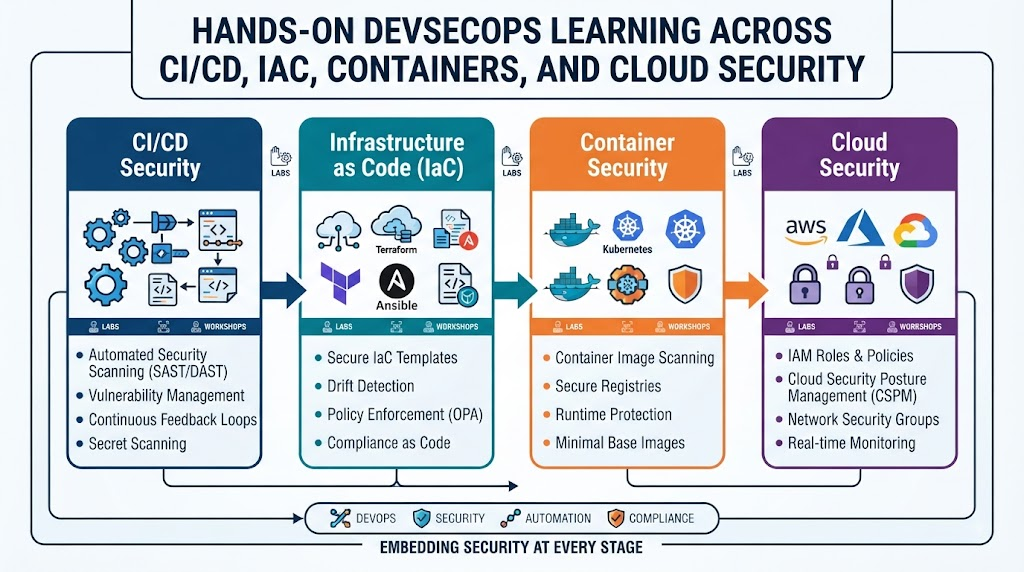
Introduction
In today’s fast-moving software world, pushing code quickly means nothing if your system is wide open to attacks. The DevSecOps Certified Professional (DSOCP) credential is built specifically to solve this tension by weaving security right into the heartbeat of the development lifecycle. For software engineers, site reliability engineers, and platform teams, learning how to secure applications early is a career game-changer. This guide breaks down what the DevSecOps Certified Professional (DSOCP) offers, who it is for, and how it can shape your technical journey. Hosted through DevOpsSchool, this program gives you practical, hands-on experience rather than just textbook theory.
What is the DevSecOps Certified Professional (DSOCP)?
The DevSecOps Certified Professional (DSOCP) is a hands-on badge of honor that proves you know how to lock down modern cloud-native systems. It exists to replace slow, manual security reviews with automated safety checks that run seamlessly inside development pipelines. Instead of multiple-choice guessing games, this curriculum throws you into real-world scenarios involving broken pipelines, vulnerable code, and compliance errors. It matches the exact workflows used by top engineering teams today. By focusing on real execution, it ensures you can defend enterprise infrastructure without slowing down deployment speeds.
Who Should Pursue DevSecOps Certified Professional (DSOCP)?
This certification is tailor-made for any tech professional looking to master security in modern cloud environments. Developers who want to write cleaner, safer code will find the foundational modules incredibly practical. SREs and cloud engineers will learn how to protect the underlying infrastructure and configuration files. Traditional security experts can use this path to shift from passive auditors into active, hands-on pipeline builders. Engineering managers also take this track to better understand how to guide their teams toward secure and efficient software delivery.
Why DevSecOps Certified Professional (DSOCP)
As companies shift everything to the cloud, securing the software supply chain has become a top priority for businesses everywhere. Engineers who know how to automate security testing and fix container vulnerabilities are in massive demand globally. This credential stays relevant because it teaches foundational engineering habits rather than focusing on tools that might disappear tomorrow. It gives you long-term career stability by teaching methodologies that work across any CI/CD platform. Ultimately, it pays off by making you a more confident engineer who can prevent costly breaches before they happen.
DevSecOps Certified Professional (DSOCP) Certification Overview
The DevSecOps Certified Professional (DSOCP) program is delivered via and hosted on. The learning approach blends expert instruction with rigorous practical challenges to test your actual capabilities. Industry veterans designed the curriculum to match current security threats and modern tool sets. The training is split into logical modules covering threat modeling, automated scanning, secret management, and incident response. Your final assessment tests your ability to secure a live pipeline and fix simulated security breaches under real pressure.
DevSecOps Certified Professional (DSOCP) Certification Tracks & Levels
The program is organized into foundation, professional, and advanced levels to match your current experience in the tech industry. Foundation levels cover basic security ideas and simple pipeline scanning tools for engineers starting out. Professional levels dig deeper into container hardening, infrastructure code analysis, and automated policy rules. Advanced tracks are designed for senior architects building zero-trust networks and enterprise security frameworks. Specialization paths let you focus on niche areas like container defense or compliance auditing. This step-by-step layout helps you map your learning directly to your career growth.
Complete DevSecOps Certified Professional (DSOCP) Certification Table
| Track | Level | Who it’s for | Prerequisites | Skills Covered | Recommended Order |
| DevSecOps | Foundation | Junior Developers, Admins | Basic Linux and Git | SAST, DAST, Pipeline Basics | 1 |
| DevSecOps | Professional | DevOps & SRE Engineers | Foundation or experience | Container Security, IaC Scanning | 2 |
| DevSecOps | Advanced | Security Architects | Professional level | Zero Trust, Policy as Code | 3 |
| DevSecOps | Specialist | Platform Security Leads | Advanced level | Secret Rotation, Compliance | 4 |
Detailed Guide for Each DevSecOps Certified Professional (DSOCP) Certification
DevSecOps Certified Professional (DSOCP) – Foundation Level
What it is
This level validates your grasp of basic security integration within development lifecycles and introductory vulnerability scanning tools.
Who should take it
Junior developers and system administrators wanting to pick up core security habits for modern workflows.
Skills you’ll gain
- Understanding shift-left security concepts
- Running basic Static Application Security Testing (SAST)
- Introduction to Dynamic Application Security Testing (DAST)
- Handling basic configuration secrets safely
Real-world projects you should be able to do
- Add a vulnerability scanner to a GitHub or GitLab pipeline
- Scan source code for accidentally exposed API tokens
- Create basic compliance reports for your development team
Preparation plan
- 7–14 days: Review basic pipeline setups and core security principles.
- 30 days: Complete labs focused on basic tool integration.
- 60 days: Build a test pipeline with security gates and fix common scan warnings.
Common mistakes
- Trusting automated scanner output blindly without reading the code.
- Ignoring low-level warnings that could add up to major security gaps.
- Viewing security as a single end-of-project gate instead of a continuous habit.
Best next certification after this
- Same-track option: DevSecOps Professional Level
- Cross-track option: Certified DevOps Foundation
- Leadership option: Secure Engineering Management Track
DevSecOps Certified Professional (DSOCP) – Professional Level
What it is
This level proves your ability to secure container workloads, manage vulnerability fixes, and scan infrastructure configuration files.
Who should take it
Mid-level DevOps and cloud engineers who manage production pipelines every day.
Skills you’ll gain
- Container image vulnerability scanning
- Infrastructure as Code (IaC) security checks
- Automated software bill of materials (SBOM) generation
- Runtime container monitoring basics
Real-world projects you should be able to do
- Write secure Dockerfiles with multi-stage build checks
- Scan Terraform templates for misconfigurations before deployment
- Set up alerts for strange runtime activity in container clusters
Preparation plan
- 7–14 days: Study container architecture and orchestration security rules.
- 30 days: Practice running IaC scanners and generating SBOMs.
- 60 days: Build and test a fully hardened container workflow in a staging setup.
Common mistakes
- Forgetting to update base container images after the initial setup.
- Missing cloud infrastructure mistakes during pipeline runs.
- Setting no clear limits for what security warnings should break a build.
Best next certification after this
- Same-track option: DevSecOps Advanced Level
- Cross-track option: Certified Site Reliability Engineer
- Leadership option: DevSecOps Leadership and Governance
DevSecOps Certified Professional (DSOCP) – Advanced Level
What it is
This level validates top-tier mastery in designing zero-trust networks, enforcing policy as code, and handling enterprise threat models.
Who should take it
Senior security architects and lead platform engineers managing large multi-cloud setups.
Skills you’ll gain
- Building zero-trust network designs
- Enforcing rules using Open Policy Agent (OPA)
- Advanced threat modeling and automated responses
- Managing enterprise-scale secrets rotation
Real-world projects you should be able to do
- Enforce cluster security rules automatically using policy engines
- Deploy a centralized and secure secret management system
- Set up automated containment workflows when threats are detected
Preparation plan
- 7–14 days: Review zero-trust frameworks and threat modeling tactics.
- 30 days: Write and test complex policy-as-code scripts.
- 60 days: Design a complete end-to-end secure deployment model with automated safety triggers.
Common mistakes
- Setting up policies so strict that normal business apps cannot deploy.
- Struggling to scale secret managers across multiple cloud regions.
- Forgetting to train the team on new zero-trust workflows.
Best next certification after this
- Same-track option: DevSecOps Expert Specialist
- Cross-track option: Certified Enterprise Platform Architect
- Leadership option: Chief Information Security Officer Advisory Track
Choose Your Learning Path
DevOps Path
The DevOps path focuses on mastering automation, integration, and deployment pipelines across distributed systems. Engineers learn configuration management and release orchestration to make software delivery fast and reliable. This acts as the essential operational base before adding advanced security layers on top.
DevSecOps Path
The DevSecOps path bakes security directly into every single stage of the software development lifecycle. Learners tackle automated vulnerability scanning, container defense, and policy rules inside pipelines. This prepares you to protect cloud-native systems without slowing down team velocity.
SRE Path
The SRE path is all about system stability, high availability, observability, and smooth incident management. Engineers learn to set service level targets, manage deep monitoring, and run blameless post-mortems. This ensures secure systems can handle heavy production traffic without failing.
AIOps / MLOps Path
The AIOps and MLOps path deals with the unique operational hurdles of launching and watching machine learning models. Professionals learn to secure AI pipelines, track model drift, and scale resources automatically. This connects standard platform engineering with modern data science needs.
DataOps Path
The DataOps path focuses on smoothing out data pipelines, checking data health, and managing large data stores safely. Practitioners learn automated data flows, governance rules, and query performance tuning. This is vital for companies relying on fast, secure analytics.
FinOps Path
The FinOps path centers on cloud financial control, cost saving, and spending accountability in multi-cloud setups. Engineers and managers learn to track expenses, split costs properly, and set spending guardrails. This makes sure technical scaling matches real business budgets.
Role to Recommended DevSecOps Certified Professional (DSOCP) Certifications
| Role | Recommended Certifications |
| DevOps Engineer | DevSecOps Foundation, DevSecOps Professional |
| SRE | DevSecOps Professional, Advanced Infrastructure Security |
| Platform Engineer | DevSecOps Advanced, Policy as Code Specialist |
| Cloud Engineer | DevSecOps Foundation, Container Security Specialist |
| Security Engineer | DevSecOps Professional, Advanced Threat Modeling |
| Data Engineer | Secure Data Pipelines, DevSecOps Foundation |
| FinOps Practitioner | Cost Governance and Security Integration |
| Engineering Manager | DevSecOps Leadership and Enterprise Governance |
Next Certifications to Take After DevSecOps Certified Professional (DSOCP)
Same Track Progression
Moving up the same track means shifting from hands-on tasks into high-level architecture and governance roles. You can target niche credentials in threat hunting, advanced compliance, or zero-trust design. This depth makes you a recognized authority and opens doors to principal engineering roles.
Cross-Track Expansion
Branching out helps you pick up useful skills in site reliability, platform building, or cloud cost management. Mixing security knowledge with reliability engineering makes you a well-rounded expert who understands the whole picture. Companies love hiring professionals who can handle multiple facets of cloud engineering.
Leadership & Management Track
Moving into leadership shifts your focus from writing scripts to guiding overall security strategy and supporting teams. Leaders learn to tie security choices to business goals, manage audits, and build a culture where everyone shares responsibility. This prepares you for director and executive positions.
Training and Certification Support Providers for DevSecOps Certified Professional (DSOCP)
DevOpsSchool is a top-tier global platform providing deep training, hands-on practice labs, and certification paths for modern tech stacks. They offer organized courses created by industry veterans to help workers master real-world production setups.
Cotocus focuses on enterprise tech training, consulting, and digital upgrades designed for modern engineering organizations. Their programs help close skill gaps through practical coaching and real business examples.
Scmgalaxy is a long-running community and training hub focused on configuration management, DevOps, and delivery cycles. It serves as a great knowledge base for engineers looking for deep technical tips and shared learning resources.
BestDevOps provides focused study materials, learning paths, and practical tutorials built to boost cloud and automation skills. Their material focuses on real-world use cases to help working engineers grow in their careers.
devsecopsschool.com offers specialized training programs centered entirely around security integration, vulnerability handling, and pipeline implementation. The platform delivers targeted courses that help teams build safer deployment workflows.
sreschool.com specializes in site reliability training, teaching people how to build scalable, resilient, and observable distributed systems. Their programs cover incident response, service level agreements, and automation techniques.
aiopsschool.com provides advanced learning for AI operations, focusing on machine learning automation, system tracking, and scaling. The platform prepares engineers to manage the heavy demands of modern AI workloads.
dataopsschool.com delivers targeted learning for data pipeline automation, data health management, and secure storage ops. Their courses help data engineers build clean, reliable, and secure data ecosystems.
finopsschool.com focuses on cloud cost management, budget strategy, and automated financial guardrails for multi-cloud setups. The platform helps professionals match their technical scaling with smart financial planning.
Frequently Asked Questions
1. How difficult is the DevSecOps Certified Professional (DSOCP) exam?
The exam is quite challenging because it tests real, practical execution rather than memorized theory. You have to configure working pipelines, fix live security flaws, and pass checks in simulated environments.
2. What are the prerequisites for taking this certification?
You should know basic Linux administration, Git version control, and standard CI/CD pipeline concepts. Familiarity with Docker and basic cloud hosting is also very helpful before jumping into professional levels.
3. How long does it typically take to prepare for the certification?
Most working professionals take between four to eight weeks of steady study. Spending five to ten hours a week on hands-on labs and pipeline practice is usually enough to get ready.
4. Is this certification recognized globally?
Yes, the credential is respected worldwide by tech firms, large enterprises, and global agencies looking for verified cloud security talent. It validates practical skills that apply to any tech stack.
5. What is the return on investment (ROI) for this certification?
Certified professionals often see faster career growth, better pay offers, and higher demand for senior engineering spots. Companies benefit through fewer security incidents and quicker patch times.
6. Are hands-on labs included in the training program?
Yes, the training comes with rich practical labs that mimic real production security problems and pipeline setups. These exercises are crucial for passing the practical evaluations.
7. How often should certified professionals renew their credentials?
Because security tools and cloud standards change fast, it is smart to keep learning and check for updates. Professionals usually review new module releases every couple of years.
8. Can beginners with no DevOps background take this course?
Beginners can start at the foundation level, but knowing basic software development and IT infrastructure makes the journey much easier. Starting with general DevOps concepts first is often a smart move.
9. What tools are covered during the certification training?
The curriculum covers a wide range of popular open-source and commercial tools for static checks, vulnerability scanning, and secret storage. You gain exposure to tools widely used in modern enterprise pipelines.
10. How does this certification differ from traditional security credentials?
Old-school security certs usually focus heavily on paperwork, compliance checklists, and theory. This certification focuses on automated engineering tasks built directly into active deployment pipelines.
11. What support is available if I get stuck during preparation?
Students get access to expert trainers, community discussion boards, and detailed guides through the learning platform. Instructors are ready to help clear up tough concepts and unblock your labs.
12. How do I register for the official certification exam?
You can sign up, check prerequisites, and schedule your test slots directly through the official course provider website. Once you finish your learning modules, you can book your assessment.
FAQs on DevSecOps Certified Professional (DSOCP)
1. What specific security scanning tools are practiced in the DSOCP labs?
The labs use top open-source and enterprise tools for static code review, dependency scanning, and infrastructure checks. Students get direct practice with tools deployed in real production pipelines.
2. Does the certification cover Kubernetes and container security in depth?
Yes, container and Kubernetes cluster security form a major part of the professional and advanced tracks. You learn about pod standards, network rules, and runtime threat defense.
3. How is the practical exam evaluated and graded?
The test uses automated grading scripts and validation checks to ensure your pipeline runs securely and meets specific rules. This guarantees a fair, performance-based review of your actual skills.
4. Can I integrate these security practices into existing Jenkins or GitLab pipelines?
The course methods are tool-agnostic, meaning you can apply these security gates to Jenkins, GitLab, GitHub Actions, or Tekton. Practical tasks help you wire security checks into your favorite CI/CD platform.
5. What is the difference between Foundation and Professional DSOCP levels?
Foundation covers basic security awareness, shift-left ideas, and simple scanner setup for junior staff. Professional dives deep into container hardening, IaC scanning, and automated fix workflows.
6. How does DSOCP address secret management in cloud environments?
The program teaches safe secret injection, avoiding hardcoded passwords, and setting up automatic secret rotation. Students practice hooking secret managers into deployment workflows to protect sensitive data.
7. Will this certification help me pass enterprise security and compliance audits?
Yes, by teaching policy-as-code and compliance checks, the certification helps your team maintain continuous audit readiness. You can easily prove adherence to security guidelines.
8. Is there ongoing access to lab environments after course completion?
Training providers usually offer structured lab access windows so you can keep practicing your skills. Extended lab time lets you test new configurations safely before touching production systems.
Final Thoughts
Bringing DevSecOps to life is a mix of cultural change and hands-on technical work that requires real skills. The DevSecOps Certified Professional (DSOCP) offers a clear roadmap for engineers who want to build secure, scalable, and automated cloud systems. By focusing on practical execution and realistic scenarios, it gives you the confidence to handle tough security challenges. Whether you are launching your security career or validating advanced architecture skills, this credential offers lasting professional value. Keep your curiosity alive, put effort into the labs, and focus on building resilient pipelines that keep development moving safely.
Leave a Reply