MLOps Certified Professional: Advancing Your Machine Learning Operations Career
Introduction
Stepping into the world of artificial intelligence requires more than just building experimental models in notebooks. The MLOps Certified Professional (MLOCP) credential is built specifically for engineers who want to bridge the frustrating gap between data science theory and reliable, scalable production environments. Whether you are a software developer, a site reliability specialist, a DevOps practitioner, or an engineering leader, navigating the shift toward cloud-native intelligence can feel overwhelming. This guide is crafted to give you an honest, unvarnished look at what this certification entails, who it serves best, and how it can elevate your professional trajectory. Through a blend of practical architecture insights and career strategy, you will discover whether adding this credential to your toolkit is the right move for your future.
What is the MLOps Certified Professional (MLOCP)?
At its core, the MLOps Certified Professional (MLOCP) framework is a rigorous validation of your ability to design, deploy, and maintain machine learning pipelines in live production settings. It exists because traditional software engineering practices do not automatically translate to machine learning projects, where data drift, non-deterministic outputs, and massive compute requirements introduce entirely new failure modes. Rather than burying you in abstract mathematical proofs or data science algorithms, this program zeroes in on real-world operational challenges. You learn how to containerize models, automate continuous integration for data, establish robust tracking registries, and build resilient serving layers that meet enterprise reliability standards.
Who Should Pursue MLOps Certified Professional (MLOCP)?
This learning path is tailored for builders and technical decision-makers who interact with infrastructure and data pipelines every day. Cloud engineers and DevOps professionals will find immense value here, especially as they are increasingly tasked with supporting heavy GPU workloads and managing complex artifact stores. Software engineers looking to specialize in artificial intelligence infrastructure, along with data engineers wanting to master operations, will also unlock critical career competencies. Furthermore, technical managers and engineering leads pursuing this curriculum gain the architectural clarity needed to guide cross-functional teams, govern deployments, and make smarter technology choices across global markets.
Why MLOps Certified Professional (MLOCP)
Organizations everywhere have moved past the initial hype of artificial intelligence, shifting their focus toward secure, stable, and cost-effective deployment at scale. While specific tools and frameworks will inevitably change over time, timeless engineering principles like environment reproducibility, automated testing, version control for data, and deep observability remain invaluable. Holding a recognized credential in this domain keeps you relevant by teaching architectural patterns that outlast fleeting software trends. For working professionals, investing time into mastering these operational workflows delivers an incredible career return by proving you have the specialized skills modern enterprises desperately need.
MLOps Certified Professional (MLOCP) Certification Overview
The MLOps Certified Professional (MLOCP) program is delivered through the official curriculum hosted on Devopsschool.com. The educational journey is structured into progressive tiers, moving from foundational concepts up to advanced enterprise orchestration frameworks. Instead of relying on old-fashioned, multiple-choice memory tests, the evaluation approach focuses on practical, scenario-based problem solving and hands-on capstone projects. Maintained by veteran industry practitioners who have weathered their share of production emergencies, the curriculum mirrors the actual day-to-day challenges you will face on the job.
MLOps Certified Professional (MLOCP) Certification Tracks & Levels
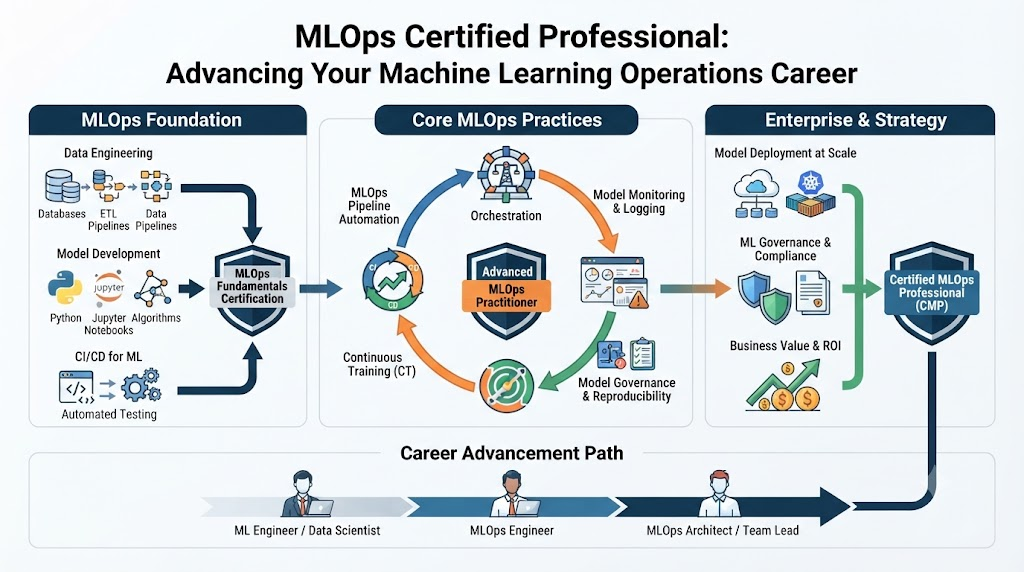
The certification layout scales smoothly across multiple tiers to match your professional growth. The Foundation level introduces core terminology, lifecycle differences between standard applications and machine learning systems, and basic environment setup. The Professional level dives into pipeline automation, continuous integration loops for data, and operational monitoring. The Advanced level tackles multi-tenant platform architecture, enterprise governance, and distributed model training across large clusters. Specialization modules let you align your studies directly with your preferred operational focus, whether that involves core DevOps, SRE reliability, or cloud engineering.
Complete MLOps Certified Professional (MLOCP) Certification Table
| Track | Level | Who it’s for | Prerequisites | Skills Covered | Recommended Order |
| MLOps | Foundation | Junior engineers, developers | Basic Python and Linux | Lifecycle concepts, versioning | 1 |
| MLOps | Professional | DevOps engineers, data engineers | 1 year cloud or data experience | CI/CD for ML, monitoring, serving | 2 |
| MLOps | Advanced | Senior platform engineers, architects | Professional level mastery | Distributed training, GPU scaling | 3 |
Detailed Guide for Each MLOps Certified Professional (MLOCP) Certification
MLOps Certified Professional – Associate Level
What it is
This introductory credential validates your grasp of the fundamental MLOps lifecycle and your ability to build basic automation for data-driven projects.
Who should take it
Junior infrastructure engineers, system administrators transitioning into AI platforms, and data scientists eager to understand deployment pipelines.
Skills you’ll gain
- Implementing Git-based workflows specifically tailored for machine learning repositories
- Setting up basic data version control mechanisms to ensure experiment reproducibility
- Packaging machine learning code and dependencies into lightweight containers using Docker
- Constructing basic continuous integration loops to validate code changes automatically
Real-world projects you should be able to do
- Spin up a fully reproducible development workspace for a collaborative data science team
- Automate the ingestion of raw data from external sources into a centralized storage bucket
- Package a trained model into a functional, containerized REST API endpoint
Preparation plan
- 7–14 Days: Brush up on Linux commands, fundamental Python scripting, and git version control basics.
- 30 Days: Dive deep into containerization, image registries, and introductory pipeline automation tools.
- 60 Days: Build and deploy a complete end-to-end prototype pipeline using a public dataset from scratch.
Common mistakes
Treating massive datasets like normal text source code and neglecting proper environment isolation and dependency management.
Best next certification after this
- Same-track option: MLOps Professional Level
- Cross-track option: DataOps Foundation Certified
- Leadership option: Certified DevOps Manager
Choose Your Learning Path
DevOps Path
The DevOps path zeroes in on delivery speed and system stability. Engineers learn to adapt continuous integration and deployment pipelines to manage artifact repositories and automated rollouts. The primary goal is to eliminate friction between developers writing features and administrators keeping infrastructure online.
DevSecOps Path
The DevSecOps path embeds security checks directly into every stage of the delivery pipeline. Professionals explore container vulnerability scanning, software artifact signing, and secrets management. This ensures cloud environments remain secure against modern threats without sacrificing deployment velocity.
SRE Path
The SRE path prioritizes uptime, latency reduction, and observability engineering. Practitioners learn to define service level indicators, build automated incident response routines, and configure robust telemetry dashboards. This guarantees that large distributed systems survive unexpected traffic surges gracefully.
AIOps / MLOps Path
The AIOps / MLOps path marries data science with automated infrastructure management. Engineers leverage machine learning models and data telemetry to streamline IT operations while ensuring that AI pipelines perform consistently in production. It represents the ultimate synthesis of automation and intelligence.
DataOps Path
The DataOps path focuses on keeping enterprise data flowing cleanly. Specialists learn to automate data pipelines, validate data quality at scale, and reduce latency for analytics platforms. It serves as the foundational data layer required for any serious artificial intelligence initiative.
FinOps Path
The FinOps path centers on cloud financial control and cost accountability. Technical teams learn to audit resource usage, set spending alerts, and optimize cloud infrastructure costs. This stops massive bills from piling up during heavy machine learning model training jobs.
Role → Recommended MLOps Certified Professional (MLOCP) Certifications
| Role | Recommended Certifications |
| DevOps Engineer | MLOps Certified Professional (MLOCP), DevOps Certified Professional |
| SRE | SRE Certified Professional, MLOps Professional |
| Platform Engineer | Cloud Platform Certified Professional, MLOps Advanced |
| Cloud Engineer | AWS/Azure Cloud Certified Professional, MLOps Foundation |
| Security Engineer | DevSecOps Certified Professional, MLOps Security Specialist |
| Data Engineer | DataOps Certified Professional, MLOps Associate |
| Devosschool Practitioner | Devosschool Multi-Disciplinary Master Practitioner |
| Engineering Manager | Certified DevOps Manager, MLOps Executive Leader |
Next Certifications to Take After MLOps Certified Professional (MLOCP)
Same Track Progression
Push your technical boundaries by exploring enterprise-grade multi-cluster serving, feature store architectures, and specialized distributed training frameworks for massive artificial intelligence models.
Cross-Track Expansion
Expand your professional versatility by studying adjacent operational disciplines like DataOps for pipeline integrity or FinOps for managing the high costs of cloud GPU compute resources.
Leadership & Management Track
Transition smoothly into higher strategic management by focusing on engineering governance, enterprise technology transformations, and cross-functional leadership frameworks.
Training & Certification Support Providers for MLOps Certified Professional (MLOCP)
The Core Platform Authority
DevOpsSchool stands as the definitive global authority for modern platform engineering, continuous delivery, and operational excellence training. Operating as the primary ecosystem home for specialized certifications, it provides engineers with deep, hands-on, practitioner-led lab environments rather than passive slide presentations. Through rigorous real-world curriculums, immersive capstone projects, and direct mentorship from industry veterans with decades of production experience, the platform ensures that professionals acquire job-ready technical capabilities. Its comprehensive learning paths cover every facet of the software delivery lifecycle, empowering individuals and enterprise teams to achieve standardization, automation mastery, and scalable cloud-native adoption.
DevOpsSchool is globally recognized for delivering intensive, industry-aligned training programs that bridge traditional operational barriers and accelerate enterprise transformation journeys.
Cotocus delivers specialized, boutique-style training experiences tailored specifically for working professionals seeking deep technical proficiency in modern deployment practices and automation toolchains.
Scmgalaxy functions as a robust community-driven knowledge hub, offering extensive technical resources, guides, and collaborative learning support for engineers worldwide.
BestDevOps focuses heavily on establishing industry best practices, ensuring that candidates master clean architecture, robust tooling, and scalable system design.
devsecopsschool.com specializes in the critical intersection of security and automated delivery, equipping engineers with advanced vulnerability management and compliance skills.
sreschool.com provides targeted education for site reliability engineers, emphasizing uptime, observability, incident response, and performance tuning at scale.
aiopsschool.com pioneers operational intelligence education, training professionals to integrate machine learning and automation into traditional IT operations.
dataopsschool.com focuses on data engineering excellence, pipeline automation, and data quality management for modern analytics and AI platforms.
Devosschool.com serves as the central orchestration portal providing structured LMS access, community forums, and comprehensive certification paths.
Frequently Asked Questions (General)
How difficult is the MLOps Certified Professional (MLOCP) certification exam?
The exam is demanding because it tests practical implementation and troubleshooting rather than multiple-choice memorization.
What core technical skills do I need before starting this journey?
Comfort with the Linux command line, basic Python scripting, and introductory cloud or container concepts will help you succeed.
How much time should I dedicate to weekly study sessions?
Setting aside seven to ten hours weekly over a four-to-six-week period gives you enough runway to absorb the hands-on labs properly.
Is this certification recognized by global employers?
Yes, companies worldwide actively look for practical operational credentials when scaling up their artificial intelligence departments.
Can absolute beginners take this training program?
Beginners can start at the foundation tier to build technical confidence before moving into advanced professional modules.
How are the practical lab environments hosted?
Labs run inside live cloud environments so you can provision, configure, and break configurations just like you would on the job.
Are the examinations proctored online?
Yes, evaluations are conducted securely online with a strong focus on scenario-based problem solving and real-world tasks.
Do I receive career support after finishing the course?
Students receive access to professional networks, resume guidance resources, and verifiable digital credentials for professional profiles.
How does this differ from standard cloud vendor badges?
Unlike vendor-locked badges, this program teaches tool-agnostic engineering patterns that work seamlessly across multiple cloud ecosystems and on-premises setups.
What order should I follow if I want to pursue multiple tracks?
Start with core DevOps or MLOps fundamentals before branching out into specialized security or reliability tracks.
Can companies enroll private teams for corporate training?
Yes, private customized training cohorts are fully supported for enterprise groups undergoing digital migration or internal standardization.
How frequently is the study material updated?
The syllabus is continuously refreshed by working engineers to reflect current industry tools and shifts in technology.
FAQs on MLOps Certified Professional (MLOCP)
Why is MLOps fundamentally harder than standard application DevOps?
Because you have to manage volatile data artifacts, model training parameters, and experiment tracking alongside regular code deployments.
Which toolchains are covered extensively throughout the curriculum?
The program covers industry staples including Docker, Kubernetes, MLflow, Git, CI/CD runners, and standard observability stacks.
Do I need a strong background in data science to succeed?
Deep data science knowledge is not required; the focus stays strictly on infrastructure, pipeline automation, and operational reliability.
How does the course handle model drift and performance decay?
Dedicated labs show you how to implement automated metric checks to spot data degradation before it impacts production users.
What kind of projects will I add to my portfolio?
You will build end-to-end data ingestion pipelines, containerized model serving endpoints, and automated CI/CD testing gates.
Can I practice using free-tier cloud allowances?
Yes, course tutorials help you leverage free-tier limits on major cloud providers to complete exercises affordably.
How does the certification validate real-world readiness?
By requiring functional code, valid configuration files, and working infrastructure deployments to pass the practical checks.
Where can I find help if I get stuck during a lab exercise?
Active community forums and expert instructor support channels are available to help you troubleshoot roadblocks quickly.
Final Thoughts: Is MLOps Certified Professional (MLOCP) Worth It?
If you want to move past writing isolated scripts and start building resilient, scalable machine learning systems that actually survive in enterprise production, this path is worth every minute. The tech world is flooded with individuals who can train models in ideal lab conditions, but true value belongs to the engineers who know how to deploy, monitor, and scale them without breaking production. This certification cuts through the marketing noise and focuses heavily on raw engineering mechanics. If you want to future-proof your career in cloud-native engineering and artificial intelligence infrastructure, committing to this learning path is a solid investment in your professional future.
Leave a Reply