Mastering Cloud Financial Management Through FinOps Education and Career Growth
Introduction
Cloud computing has completely transformed how businesses build and scale technology, yet keeping track of runaway cloud bills remains a daily headache for many organizations. Without a clear strategy, spending often outpaces actual business value, turning cloud financial management into an urgent operational priority. FinOps brings engineering, finance, and leadership teams together to ensure every dollar spent in the cloud drives measurable results. Structured educational paths help bridge the gap between technical infrastructure choices and financial transparency. Platforms like FinOpsSchool.com offer practical resources for individuals and enterprises looking to build these vital cost-control capabilities.
What is FinOps?
FinOps stands for Cloud Financial Operations, acting as both a cultural practice and a discipline that brings financial accountability to the flexible nature of cloud spending. It helps organizations extract maximum business value by encouraging engineering, finance, and business teams to collaborate closely on spending decisions.
In older IT models, hardware budgets were mapped out years in advance. Today, anyone with cloud access can spin up resources instantly, shifting capital expenses into ongoing operational costs. FinOps introduces visibility and accountability by equipping teams with clear data on who is spending money and why. Through targeted FinOps Training, teams discover how to monitor usage, attribute costs accurately, and make balanced choices that support both speed and fiscal health.
Why FinOps Skills Matter Today
As companies migrate deeper into the cloud, managing expenses ceases to be a task reserved strictly for the finance department. Many businesses face unexpected billing surprises because engineering teams naturally prioritize high performance while finance teams focus primarily on rigid budgets, resulting in a communication barrier.
Mastering this discipline allows organizations to resolve everyday friction points like idle resource waste, poor visibility, and inaccurate forecasting. Professionals equipped with these capabilities can directly connect technical architecture decisions to bottom-line business outcomes, making cloud operations far more sustainable over the long haul.
FinOps Training for Practical Skill Development
Moving beyond basic documentation is essential for anyone wanting to master cloud financial management. A comprehensive FinOps Training curriculum helps participants grasp critical topics such as cost allocation models, smart budgeting, precise forecasting, and cloud governance.
Learners dive into building a cost-aware culture where technical teams keep expenses top of mind without sacrificing velocity or innovation. These programs focus heavily on practical scenarios, ensuring participants can seamlessly turn high-level financial theories into daily working habits.
FinOps Certification for Professional Growth
Earning a formal credential is a reliable way to showcase verified expertise to current employers and industry peers. Achieving a FinOps Certification proves that a practitioner truly understands core economic principles, cloud billing dynamics, and cross-functional governance frameworks.
This validation establishes professional credibility and helps individuals stand out in a competitive job market. A structured preparation path ensures candidates don’t just memorize definitions, but learn how to apply financial oversight within complex, multi-cloud architectures.
FinOps Course for Structured Learning
Stepping into a well-organized FinOps Course allows students to explore essential topics in a logical, step-by-step format. These programs typically cover cloud economics, cost transparency, anomaly tracking, resource optimization, and executive reporting.
Following a guided curriculum eliminates the confusion of stitching together random web tutorials and fragmented guides. This organized approach helps beginners and seasoned engineers alike build a comprehensive understanding of efficient cloud money management.
FinOps Certification Training with Practical Learning
Preparing for an exam works best when paired with hands-on exercises and real-world case studies. Effective FinOps Certification Training pairs expert instruction with practical examples, demonstrating how different departments can unite to control expenses.
Students analyze realistic billing scenarios, experiment with cost-sharing models, and learn how to interpret granular usage reports. This practical foundation ensures that the skills learned translate directly into everyday workplace impact.
Corporate FinOps Training for Organizations
When an entire enterprise adopts the cloud, controlling expenditures cannot fall on the shoulders of just one individual. Corporate FinOps Training helps companies synchronize their engineering, finance, and executive leadership around common financial objectives.
Tailored team learning initiatives foster company-wide cost awareness, strengthen resource governance, and establish shared spending accountability. By training departments together, businesses break down internal silos and adopt sustainable cloud economics much more smoothly.
FinOps Online Training for Flexible Learning
Juggling a demanding job while picking up new technical skills can feel overwhelming, which is why remote education is so valuable. FinOps Online Training gives professionals the freedom to study from anywhere while still enjoying structured lessons and direct instructor support.
Virtual classrooms, archived sessions, and remote labs allow participants to learn at their own speed without disrupting their day-to-day work obligations, making advanced cloud education globally accessible.
FinOps Training in India for Professionals
With technology adoption expanding at a rapid pace across the region, companies in India are placing heavy emphasis on cloud efficiency and financial governance. FinOps Training in India provides local developers, engineers, and financial analysts with the skills required to support modern enterprise environments.
Offering a blend of online modules and instructor-led cohorts, professionals can easily upskill and position themselves for exciting new career paths in cloud financial management.
FinOps Practitioner Training
A practitioner serves as the essential link between technical engineering squads and financial stakeholders. FinOps Practitioner Training focuses on teaching individuals how to drive cultural transformation, handle expense attribution, and establish routine reporting rhythms.
Participants learn how to navigate the core lifecycle stages—inform, optimize, and operate—while working hand-in-hand with developers, managers, and finance teams to maintain healthy spending habits.
FinOps Engineer Training
Engineers who design and maintain cloud infrastructure require specialized knowledge to build cost-conscious systems. FinOps Engineer Training helps technical practitioners master resource optimization, operational automation, and continuous cost monitoring.
Learners discover how to manage container spending, configure automated scaling policies, and parse detailed usage telemetry to ensure infrastructure remains both performant and economical.
Cloud Cost Optimization Training
Managing cloud spending involves much more than simply pulling the plug on servers or slashing budgets arbitrarily. Cloud Cost Optimization Training teaches learners how to strike a healthy balance between cost, performance, system security, and reliability.
Participants discover how to detect infrastructure waste, rightsize underutilized instances, implement automation policies, and build continuous optimization loops that fuel business growth without compromising technical integrity.
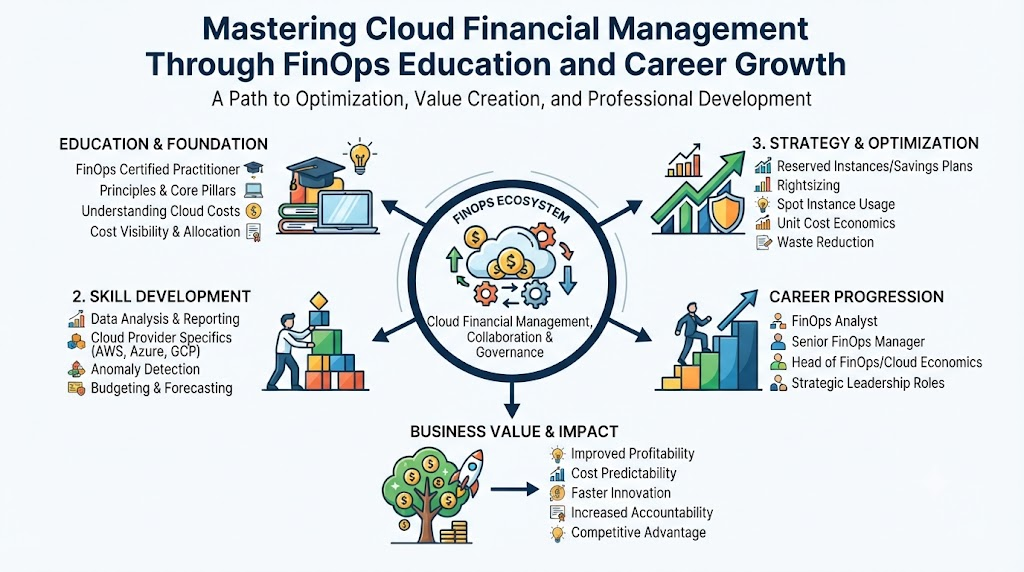
Important FinOps Skills and Concepts
- Cost Visibility: Achieving total clarity on where and how cloud funds are being consumed across various projects and departments.
- Cost Allocation: Distributing cloud expenses accurately to specific business units, products, or clients using smart tagging and labeling strategies.
- Budgeting and Forecasting: Setting strict spending boundaries and projecting future expenses based on historical usage data.
- Rightsizing: Matching cloud computing resource dimensions precisely to operational performance needs to avoid paying for excess capacity.
- Anomaly Detection: Instantly flagging unusual cost spikes to prevent unexpected end-of-month billing shocks.
- Unit Economics: Linking cloud operational expenses directly to core business metrics, such as cost per customer or cost per transaction.
FinOps Tools and Technologies
Operating modern cloud setups efficiently requires the right set of tools to monitor and interpret usage data. Several categories of software help teams keep a close eye on their environments:
- Native Cloud Provider Consoles: Built-in utilities like AWS Cost Explorer, Microsoft Cost Management, and Google Cloud Cost Management offer immediate visibility into baseline spending trends.
- Kubernetes Cost Monitoring Tools: Specialized software built to track container and cluster resource utilization across complex, microservices-driven architectures.
- Analytics and Reporting Platforms: Multi-cloud third-party dashboards that aggregate data from multiple providers to present a unified view of financial health.
- Automation and Governance Utilities: Programs that automatically enforce tagging standards, spin down non-production resources during off-hours, or alert engineers to budget deviations.
FinOps Learning Path Comparison Table
| Learning Option | Main Focus | Main Benefit |
| FinOps Training | FinOps knowledge and practical skills | Build a strong foundation |
| FinOps Certification | Knowledge validation | Demonstrate FinOps understanding |
| FinOps Course | Structured learning | Learn concepts in an organized way |
| Corporate FinOps Training | Team and organizational skills | Improve cloud cost awareness |
| FinOps Online Training | Flexible learning | Learn remotely |
| FinOps Practitioner Training | FinOps principles and collaboration | Build practitioner-level knowledge |
| FinOps Engineer Training | Engineering and cloud cost skills | Improve cost-aware infrastructure practices |
| Cloud Cost Optimization Training | Cloud spending and resource efficiency | Improve cloud cost management |
FinOps Career Opportunities
Companies of all sizes are actively searching for talent that understands both the engineering and financial dimensions of cloud computing. This expanding need has unlocked diverse career paths for knowledgeable professionals:
- FinOps Practitioner: Focuses on interdepartmental collaboration, cost attribution, and spreading financial awareness across teams.
- FinOps Engineer: Partners with development squads to fine-tune cloud architecture and automate expense guardrails.
- Cloud Cost Analyst: Specializes in parsing billing logs, building financial models, and spotting hidden spending trends.
- Cloud Financial Management Professional: Bridges corporate finance and IT strategy to oversee enterprise-wide cloud budgets.
- Cloud Architect with FinOps Skills: Designs efficient, scalable cloud environments that keep spending optimized from day one.
How FinOpsSchool.com Helps Learners
Platforms like FinOpsSchool.com provide valuable support for individuals and teams striving to master cloud financial management. By offering structured educational pathways, exam preparation tools, and hands-on material, the platform makes it straightforward for beginners and seasoned experts alike to acquire practical skills.
Whether an infrastructure engineer wants to learn cluster optimization or a financial analyst wants to decode cloud billing data, FinOpsSchool.com delivers accessible guidance to foster continuous professional development and long-term organizational success.
Common Mistakes While Learning FinOps
- Relying purely on theory without practical application: Reading abstract concepts without looking at real billing logs makes concepts difficult to apply. Solution: Inspect actual usage data and practice setting up allocation tags in a sandbox environment.
- Treating the discipline solely as a budget-cutting exercise: Viewing FinOps strictly as a way to slash spending often harms system reliability and performance. Solution: Balance cost reduction with overall business value and technical needs.
- Working in a complete organizational silo: Trying to manage cloud budgets without looping in engineering or finance teams breeds internal friction. Solution: Build strong cross-functional partnerships and share accountability.
- Treating cloud management as a one-time project: Cloud environments evolve continuously, meaning cost monitoring must be an ongoing habit. Solution: Establish regular review routines and continuous feedback loops.
How to Choose the Right FinOps Training Program
- Seek out curricula that balance fundamental economic principles with practical, real-world cloud scenarios.
- Verify whether the program offers hands-on exercises and covers the specific cloud service providers your company utilizes.
- Ensure the instructors bring genuine, real-world industry experience in cloud financial management.
- Confirm that the learning path offers adequate support and prepares you effectively for professional certification exams.
Frequently Asked Questions
1. What is FinOps Training?
Answer: It is an educational journey that teaches professionals how to monitor, allocate, and optimize cloud expenses through close cooperation between tech and finance teams.
2. Why is FinOps Certification useful for professionals?
Answer: It formally validates an individual’s grasp of cloud financial management principles, adding professional credibility and highlighting expertise to hiring managers.
3. What is included in a FinOps Course?
Answer: Standard courses cover cloud economics, cost visibility mechanics, expense attribution, budgeting, forecasting, governance, and executive reporting frameworks.
4. Who should take FinOps Certification Training?
Answer: Cloud engineers, DevOps specialists, finance team members, IT directors, and anyone tasked with managing or budgeting for cloud infrastructure.
5. What are the benefits of Corporate FinOps Training?
Answer: It helps entire companies align their technical and financial departments, elevate cost awareness, and cultivate a shared culture of spending accountability.
6. What are the benefits of FinOps Online Training?
Answer: It delivers remote accessibility, scheduling flexibility, and structured lessons, empowering professionals to upskill while maintaining their regular job duties.
7. How can FinOps Training in India help professionals?
Answer: It equips local engineering and financial practitioners with the practical skills needed to support the rapid digital expansion happening across regional businesses.
8. What is FinOps Practitioner Training?
Answer: It is specialized instruction focused on teaching individuals how to drive cultural shifts, manage cost allocation, and foster cooperation across departments.
9. What skills are covered in FinOps Engineer Training?
Answer: It focuses on cloud infrastructure optimization, resource rightsizing, container cost control, automation routines, and cost-aware engineering habits.
10. How does Cloud Cost Optimization Training help organizations?
Answer: It trains teams to eliminate waste, maximize infrastructure efficiency, and balance expenditures with application performance and business reliability.
Final Thoughts
Managing cloud expenditures intelligently is no longer optional for organizations scaling operations in the cloud environment. Building core capabilities in this domain allows teams to transition from unpredictable bills to predictable, value-driven investments. Through structured education, practical exercises, and professional certification, individuals can acquire the expertise required to guide their enterprises toward lasting financial accountability. Educational platforms like FinOpsSchool.com offer helpful resources to support learners throughout this journey. Adopting a collaborative FinOps mindset ensures that technological innovation and economic health thrive side by side.
Leave a Reply